Standard Resources on Early Modern Handwriting
- W.W. Greg’s English Literary Autographs 1550-1650 (1932). Wikipedia describes this source as one “recognized as a significant contribution to bibliography and textual studies, offering a systematic catalog of original manuscripts and signatures from English Renaissance literary figures. Published in 1932, the collected plates are considered a vital resource for scholars examining the physical form of texts from this era and are foundational to modern Shakespearean studies.” Controversially, there is no entry for “Shakespeare.” No literary holograph — a text with signature — exists for him.
- Fairbank, Alfred; Bruce Dickins. The Italic Hand in Tudor Cambridge (Cambridge Bibliographical Society Monograph No. 5). London: Bowes & Bowes, 1962. Includes samples of around 40 Cambridge associates who practiced Italic c. 1522-1600.
- A Booke containing divers sortes of hands, as well the English as French secretarie with the Italian, Roman, chancelry & court hands. Set forth by John Beau Chesne and John Baildon. London: Thomas Vautrollier, 1570. 4 ° obl., [5] −43 f. (Chicago NL, London BL). This is the first copybook published in England to feature the Italic hand. A copy of the 1615 edition is available online at Internet Archive.
- Fairbank, Alfred and Berthold Wolpe. Renaissance Hand Writing. An Anthology of Italic Writing Scripts. London: Faber and Faber Limited, 1960.
- Tom Davis, “The Practice of Handwriting Identification,” The Library, Volume 8, Issue 3, September 2007, Pages 251–276, https://doi.org/10.1093/library/8.3.251.
Resources On Edward de Vere’s Handwriting
- “The Audley End Annotation: Applying Huber and Headrick’s Elements of Handwriting Discrimination To a 16th Century Unknown Document,” Journal of Forensic Document Examination 2023, DOI: https://doi.org/10.31974/jfde31-13-66. The most important forensic study of Edward de Vere’s handwriting. The article provides evidence that the Audley End Annotations in copies of Dionysius of Halicarnassus, Cassius Dio, and Tacitus (among other Audley End books) are in de Vere’s handwriting. It also also establishes some baseline observations about de Vere annotations and includes dozens of high resolution photos of the hand.
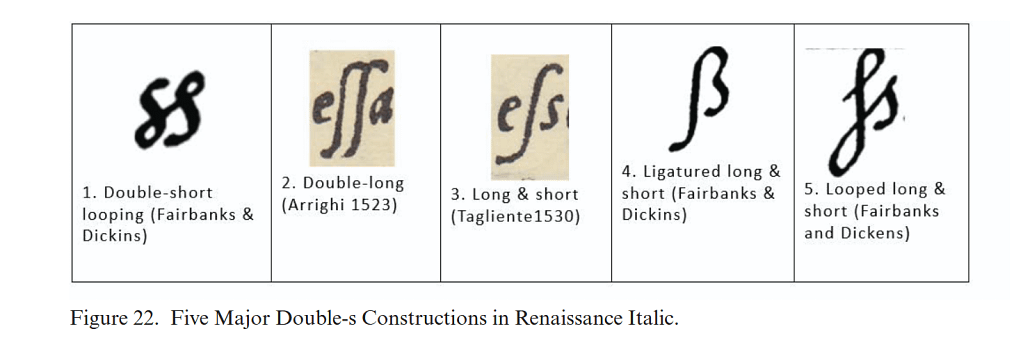
- While forensic analysts never base a conclusion on analysis of a single letter, in some cases a single letter or a pair of letters can be highly useful in forming a preliminary hypothesis. In fact, the -ss– bigram (double s) is a magic diagnostic for sorting early modern italic hands. This is because these two letters can be formed in at least five ways. Some writers mix and match more than one of these types, and some consistently favor one over the other four. The illustration below, reproduced from the JDFE paper, shows the five main types of the bigram. Types 1, 2, and 5 are rarely found in Edward de Vere’s handwriting. He favors types 3 (rarely) and type 4 (almost always). Unlike types 1 and 5, types 3 and 4 require a pen lift between the letters. They are therefore a slower, “less efficient” style. Type 1 appears already in the writings of the Cambridge Italic school (see Fairbanks and Dickens) in the 1520s. Type 5 becomes more common towards the the latter half of the Elizabethan period. It is preferred, for example, by Sir Henry Neville (1564-1615), but not by de Vere (1550-1604).
Resources on the Seneca Handwriting Problem
- Shakespeare Illustrated in Edward de Vere’s Notes In Seneca. This 388 page, two-part research report establishes that Edward de Vere is also the annotator of this book. Both forensic study of the handwriting and the conceptual linkages between the two sets of annotations confirm this conclusion. After this, the study explores some of the many dense connections between the Seneca annotations and Shakespeare.
- This recent power point, “Shakespeare’s Marginal Notes in a 1563 copy of Seneca’s Ten Tragedies,” illustrated a lecture that covered the Audley End materials before examining a few of the more remarkable Seneca notes.